My phupho’s husband has worked as a civilian employee at a Pakistan Army cantonment for over 18 years. He never wore a uniform, never went through military training, and never fired a weapon. He started as a lower division clerk in his mid-twenties with an intermediate certificate and a basic understanding of office work. Today he is a senior administrative officer with a pension waiting for him, free medical coverage for his entire family, and a calm confidence about his financial future that most people his age simply do not have.
Every few years, a younger relative asks him how he got there. His answer is always the same. He found out about civilian staff recruitment in the Army, applied properly, cleared the test, and showed up consistently for nearly two decades. That is the whole story.
Most people do not realise that the Pakistan Army employs tens of thousands of civilians across the country. These are not soldiers. They are accountants, clerks, engineers, doctors, IT staff, teachers, drivers, gardeners, sanitary workers, and dozens of other categories of workers who keep the administrative and support machinery of military installations functioning every single day.
If you are looking for stable government-linked employment in 2026 without going through military selection, this category deserves your serious attention.
What Pakistan Army Civilian Staff Actually Means
The Pakistan Army operates cantonments, hospitals, schools, colleges, supply depots, workshops, and administrative offices across Pakistan. All of these facilities need civilian staff to run their non-military functions.
Civilian employees of the Pakistan Army are government servants. They fall under the Ministry of Defence and are governed by civil service rules rather than military regulations. They receive salaries according to the Basic Pay Scale system, the same framework used across federal government employment.
The key distinction is that these employees work within a military environment, which means structured administration, serious attention to discipline and conduct, and a working culture that is noticeably more organized than many civilian government departments. People who have worked in both consistently describe Army civilian postings as more functional and less chaotic than equivalent civilian department positions.
Categories of Civilian Jobs Available
The range of positions is broader than most people expect.
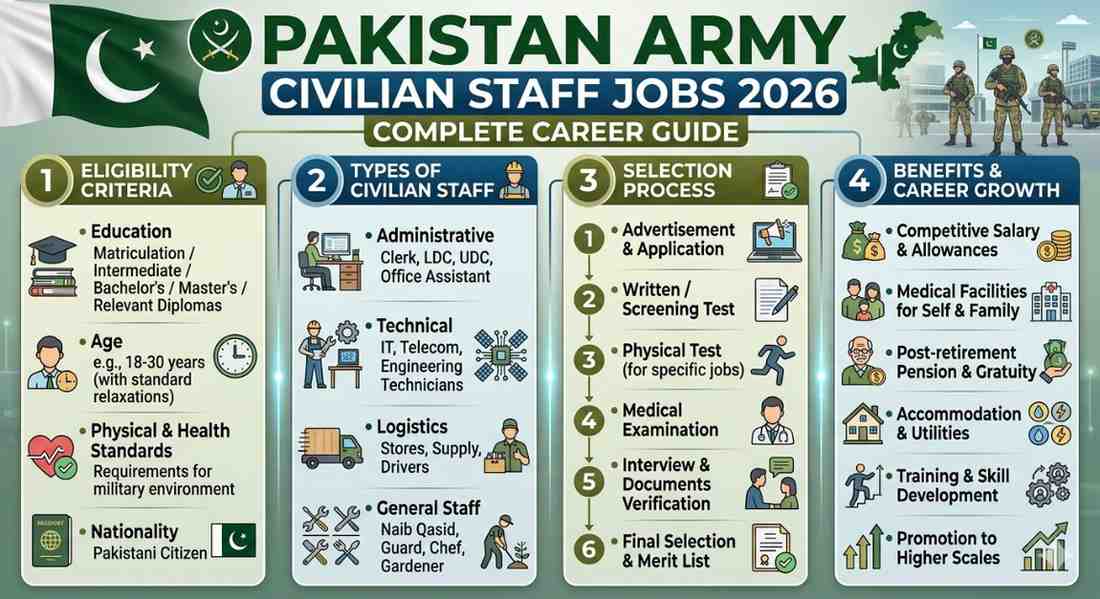
Clerical and Administrative Staff covers Lower Division Clerks, Upper Division Clerks, assistants, stenographers, and office superintendents. These are the backbone of Army administrative offices. Intermediate or graduation level education is typically required depending on grade.
Accounts and Finance Staff includes positions like accountant, auditor, cashier, and pay clerk. A commerce background is usually required. These roles exist across military pay offices, accounts sections, and financial management units.
Technical and Engineering Staff covers positions for civil engineers, electrical engineers, mechanical engineers, draughtsmen, and technical supervisors in works departments managing construction and maintenance of military infrastructure.
Medical and Health Staff includes positions at Army hospitals and medical facilities for civilian doctors, nurses, paramedics, laboratory technicians, pharmacists, and sanitary staff. CMH hospitals across Pakistan employ significant numbers of civilian health workers alongside military medical personnel.
Education Staff covers teachers and administrative staff at Army Public Schools and Colleges, one of Pakistan’s largest private school networks. These schools hire civilian teachers across all subjects and grade levels throughout the year.
IT and Computer Staff has grown substantially as Army administrative systems modernise. Computer operators, network staff, data managers, and IT support roles are increasingly part of civilian recruitment.
Industrial and Support Staff includes drivers, cooks, security guards, sanitary workers, electricians, plumbers, and maintenance staff. These positions typically require lower educational qualifications and are recruited in significant numbers regularly.
Eligibility Criteria by Category
Educational requirements vary considerably by position. Industrial and support staff positions often require only primary or middle school completion. Clerical positions typically need intermediate or graduation. Specialist positions in engineering, medicine, and IT require relevant degrees and often professional qualifications.
Age limits generally range from 18 to 30 years for most entry-level positions. Upper age relaxations apply for certain categories, including women candidates, minorities, and in some cases residents of specific regions. Always check the specific notification for exact age limits since they vary by position and recruitment batch.
Domicile requirements apply. Positions are often allocated by regional quota, so your domicile certificate must be valid and from your actual registered district. This is a document you should have updated and ready before any recruitment window opens.
Physical fitness standards for civilian positions are far less demanding than military recruitment, but a basic medical fitness examination is conducted. Certain positions like driver, security guard, and some field roles have more specific physical requirements.
Experience requirements appear for mid and senior-level positions. A position for Upper Division Clerk or Accounts Officer may require several years of relevant government or equivalent experience. Entry-level positions typically do not require prior experience.
How to Find and Apply for These Positions
Step one is knowing where to look. Pakistan Army civilian job vacancies are advertised through multiple channels. The official Army website and ISPR releases carry some announcements. The Cantonment Boards across Pakistan advertise their own civilian vacancies separately. Army Public Schools and Colleges advertise teaching positions through their own HR systems, often on their individual school websites and through regional education offices.
Major newspapers including Dawn, Jang, The News, and Nawaiwaqt remain important sources. Government job advertisement pages in these papers carry Army civilian vacancies regularly. Setting up Google Alerts for terms like “Pakistan Army civilian jobs” and “Ministry of Defence jobs Pakistan” helps you catch announcements quickly.
The NTS website at nts.org.pk is important because many Army civilian recruitments use the National Testing Service for written assessments. Registering with NTS and checking their upcoming tests section regularly will help you spot relevant exams.
Step two is preparing your documents before any window opens. This means having your CNIC, domicile certificate, educational certificates with attestation, experience certificates if applicable, and recent photographs all ready in both original and photocopy form. Recruitment windows often move quickly, and scrambling for documents after seeing an advertisement means missed deadlines.
Step three is the written test. Most civilian positions require a written examination. The content typically covers general knowledge, English, Urdu, mathematics, and subject-specific material relevant to the position. Past papers for government written tests are widely available and relevant since the format and difficulty level is fairly consistent across federal government recruitment.
Step four is the skills test where applicable. Clerical positions often include a typing assessment. Computer operator positions test basic Office skills. Stenographer positions test shorthand speed. Know what your applied position requires and practice that specific skill deliberately in the weeks before testing.
Step five is the interview. A selection committee evaluates shortlisted candidates. Be professionally dressed, speak clearly, demonstrate familiarity with the nature of the role you are applying for, and show genuine interest in the position rather than giving the impression you would take any job anywhere.
Step six is the medical examination and background verification. Both are standard for government employment. Be straightforward about your medical history and ensure there are no discrepancies between your submitted documents and verified records.
Salary Structure and Benefits
Civilian Army employees are paid according to federal Basic Pay Scale rates. Entry-level clerical positions typically fall between BPS 7 and BPS 11, translating to monthly salaries roughly between Rs. 30,000 and Rs. 55,000 at current scales, including standard allowances.
Technical and specialist positions are graded higher, often BPS 14 to BPS 17, with corresponding salaries in the Rs. 60,000 to Rs. 120,000 range or above depending on specific grade and allowances applicable.
Beyond base salary, the benefits package is genuinely significant. Medical coverage through military hospitals for the employee and immediate family. House rent allowance where government accommodation is not provided. Annual increments built into the pay scale system. Provident fund contributions. Pension after completing qualifying service years, which provides income for life after retirement.
Access to canteen facilities at subsidised rates, Army Public Schools for children at reduced fees, and various welfare schemes through Army welfare organisations are additional benefits that improve the effective value of the compensation package considerably beyond the headline salary figure.
Common Mistakes That Cost Applicants Their Chance
Applying for positions outside your educational qualification range wastes your time and the selection committee’s. Read eligibility requirements carefully before submitting anything.
Submitting applications with missing or incorrectly attested documents is one of the most common reasons for immediate disqualification. Every document requirement listed in the advertisement must be fulfilled completely. A missing attestation on one certificate can eliminate an otherwise strong application.
Ignoring the domicile quota structure leads to confusion and disappointment. If a position has a specific regional quota and your domicile is from a different area, applying regardless is simply wasted effort. Target positions where your domicile makes you eligible.
Underestimating the written test because the position seems straightforward is a consistent mistake. Government written tests are competitive because large numbers of candidates apply for relatively few positions. Preparation makes a genuine difference in your final score and rank on the merit list.
Depending on unofficial information from social media groups instead of official sources creates confusion. Advertisement details circulate informally and often contain errors about deadlines, eligibility, or required documents. Always verify everything against the original official advertisement.
The Long View on This Career
My phupho’s husband is not a dramatic success story. He did not become famous or wealthy. What he built over 18 years is something quieter and in many ways more valuable: complete financial security, a predictable and growing income, free healthcare for his family, children educated at Army Public Schools, and a pension that means retirement will not be a crisis.
For a person in 2026 weighing career options, Pakistan Army civilian staff employment represents one of the most underrated paths available. The entry requirements are realistic across a wide range of educational backgrounds, the stability is exceptional by Pakistani employment standards, and the long-term benefits compound significantly over a full career.
The opportunity exists. The question is whether you find out about it in time, prepare properly, and apply correctly when the window opens.