A neighbor’s son from our street in Rawalpindi appeared in three different government job tests last year and failed to clear any of them. He was frustrated, starting to lose confidence, and genuinely unsure what direction to take. His father mentioned it to my chacha, who had retired from the Army. My chacha asked one simple question: “Beta computer chalana aata hai?” The son said yes, he had done a basic IT diploma. My chacha told him to watch for Data Entry Operator recruitment in the Pakistan Army.
He applied. He got selected. He’s now six months into his service, stationed at a cantonment office in Lahore, earning a stable salary with full benefits, and most importantly, he looks like someone who finally found solid ground under his feet.
Data Entry Operator is one of those Army job categories that doesn’t get talked about as much as infantry or technical trades, but for someone with basic computer skills and the right profile, it’s genuinely one of the most accessible entry points into military service in 2026.
What Does a Data Entry Operator Actually Do in the Pakistan Army
People hear “data entry” and immediately picture someone mindlessly typing numbers into a spreadsheet all day. The reality inside the Army is more varied and more interesting than that.
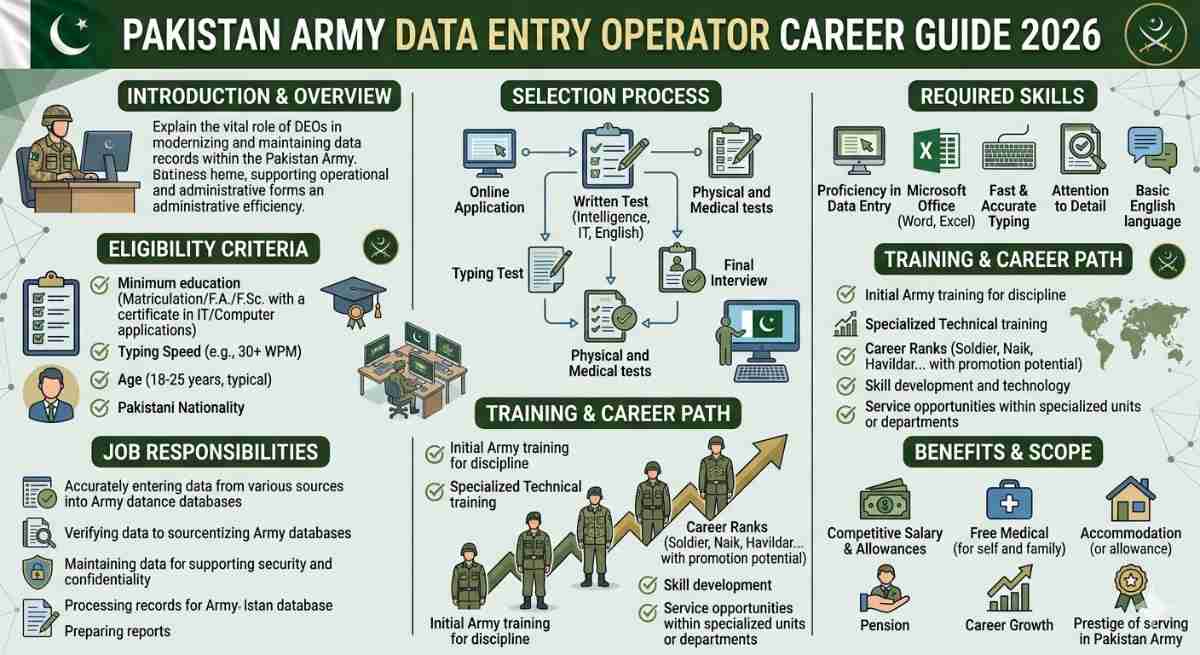
Data Entry Operators in the Pakistan Army work within the administrative and record-keeping machinery of military units, formations, and offices. They manage personnel records, maintain service documents, handle correspondence files, enter and update information in military database systems, and support the clerical functions that keep large organizations running.
As the Army has modernized its administrative systems, the role has expanded beyond just typing. DEOs now work with computerized record management systems, assist in preparing official reports and returns, manage filing systems both physical and digital, and support officers and JCOs with documentation needs.
It is desk work, structured and indoor, which for many people is exactly what they want from a military career. You serve your country without necessarily being in a combat-facing role, and you build administrative and computer skills that have genuine value throughout your career and after retirement.
Why This Role Makes Sense as a Career Choice in 2026
The Pakistan Army is a massive organization. Hundreds of thousands of personnel, dozens of corps and formations, installations spread across the entire country. All of that requires enormous administrative infrastructure. Personnel records, pay records, equipment inventories, correspondence, training records, medical files. Every piece of that documentation needs people to manage it.
DEOs sit at the center of that administrative machinery. The role is stable, the demand is consistent, and unlike many technical trades that require years of specialized training before you’re useful, a qualified DEO can contribute meaningfully within weeks of completing basic training.
For someone who has done intermediate-level education with some computer exposure, this represents a realistic and achievable path into organized military service with all the benefits that come attached.
Eligibility Criteria for Data Entry Operator
Age is typically between 17 and 23 years at the time of application. Always verify this against the specific recruitment notification since batch requirements can vary slightly.
Educational qualification is the important differentiator for this category. Most DEO recruitments require a minimum of Intermediate, meaning FA or FSc or equivalent. Some notifications specifically prefer candidates with a computer science background at intermediate level, or a recognized computer diploma from an HEC or TEVTA-affiliated institution.
Typing speed is sometimes tested during the selection process. Being able to type reasonably quickly and accurately in English matters. If your typing is slow, this is genuinely something you can improve in a few weeks of daily practice using free tools like TypingClub or Keybr on any browser.
Basic Microsoft Office proficiency is expected. Word, Excel, and sometimes PowerPoint. You don’t need to be an advanced Excel user, but being able to create and format documents, work with basic spreadsheets, and navigate Windows comfortably is important.
Physical standards still apply even though this is an administrative role. Minimum height, weight proportional to height, and medical fitness requirements are evaluated. The physical fitness test is less demanding than combat arms categories, but it is still real and requires preparation.
Domicile must match your registered district. This is non-negotiable and a very common source of problems for applicants who have been living away from their home district for education or work.
The Application Process Step by Step
Step one is monitoring official channels. Pakistan Army DEO recruitment is announced through joinpakarmy.gov.pk, ISPR official communications, and major newspapers. Recruitment windows open periodically and close quickly. Check the official website regularly rather than relying on secondhand information from social media where outdated notices often circulate and confuse applicants.
Step two is completing the online registration on joinpakarmy.gov.pk during the active recruitment window. Fill every field with accurate information. Upload clear, properly sized document scans. Mistakes at this stage create complications at every subsequent step and, in some cases, result in automatic rejection.
Step three is the written test. You will be assessed on general knowledge, English, Urdu, basic mathematics, and often computer-related questions covering fundamental concepts. The standard is not extremely high, but you need to prepare specifically rather than walking in cold. Practice papers for Pakistan Army written tests are available at most book stalls in major cities and on Pakistani educational forums online.
Step four is the computer proficiency test. This is specific to DEO selection and is where candidates with actual computer experience have a clear advantage. You may be asked to type a passage, format a document in Word, or perform basic tasks in Excel. Practice these specifically in the weeks before your test date.
Step five is the physical fitness test. Running, push-ups, sit-ups, and chin-ups. Even for an administrative role, the Army maintains physical standards. Start preparing at least two months physically before you expect to sit the test. The run distance and repetition requirements are standardized and publicly known so you can train to exactly the right targets.
Step six is the medical examination at the Army Selection and Recruitment Centre. Complete transparency about your medical history is essential. Attempting to conceal any condition and having it discovered during examination leads to permanent disqualification, which is a far worse outcome than being deferred for something treatable.
Step seven is the interview. A panel of officers will assess your communication, motivation, and general demeanor. Be straightforward about why you want to join, what you understand about the role, and demonstrate basic awareness of the organization you’re applying to join.
Training After Selection
Selected DEO candidates go through basic military training at a recruit center alongside other Army intake. This phase covers military discipline, physical conditioning, drill, and basic soldiering. It is the same foundational training that all soldiers go through regardless of their eventual role.
After basic training, DEO candidates typically receive specialized administrative and computer systems training relevant to the Army’s internal documentation and record management systems. This phase prepares you for actual posting duties and familiarizes you with the specific software and processes used within military administrative offices.
The transition from training to first posting is where the real job begins. Most DEOs are posted to unit or formation headquarters, cantonment offices, or administrative centers within military installations.
Salary and Benefits Package
Basic pay at entry level for a newly inducted soldier in the DEO category starts in the range of Rs. 25,000 to Rs. 35,000 per month. That number alone does not tell the real story of the compensation package.
Free accommodation within military quarters or a house rent allowance if you live outside. Free medical treatment for yourself and your immediate family at military hospitals and CMHs. Ration allowance. Access to canteen stores where daily essentials are available at subsidized rates. Army Public Schools for children with heavily reduced fee structures.
As you progress through grades from Sipahi to Lance Naik, Naik, Havaldar, and into the JCO ranks if you pursue that path, each promotion brings a meaningful salary increase. The structure is clear, and advancement is based on performance and time in service.
Post-retirement benefits, including monthly pension for life, gratuity payment, and access to various military welfare schemes, including housing plots through the Fauji Foundation and Army Welfare Trust, make the long-term picture very different from what the starting salary suggests.
Common Mistakes That Eliminate Good Candidates
Submitting the application without verifying domicile documentation is the single most avoidable disqualification. Your domicile must be valid, current, and from your actual registered district. Sort this paperwork out first before anything else.
Neglecting the typing component is a mistake specific to DEO applicants. Many candidates who are otherwise well prepared underperform on the practical computer test simply because they haven’t actually practiced typing and basic Office tasks recently. Use TypingClub or any free typing practice website daily for several weeks before your test.
Treating the physical test as less important because the role is administrative is a serious miscalculation. The Army applies physical standards uniformly. Show up physically unprepared, and you will be eliminated regardless of how strong your computer skills are.
Gathering information from unofficial sources creates confusion. Facebook groups and YouTube videos about Army recruitment often contain outdated or simply incorrect information about requirements, dates, and processes. The joinpakarmy.gov.pk website is the only source you should trust for current eligibility details and application procedures.
Using agents or middlemen who claim to guarantee selection is both financially harmful and legally risky. Army recruitment has standard procedures and no legitimate shortcut exists through third parties.
What This Career Looks Like Long Term
The DEO role is an entry point, not a ceiling. Within the Army’s administrative stream, capable soldiers move into clerical officer roles, administrative NCO positions, and eventually JCO grades with enough service and performance. Some DEOs cross-train into other administrative functions or take on supervisory responsibilities over time.
The skills built during service- structured record management, database operation, official correspondence, administrative coordination- translate well into civilian roles after retirement. Government departments, corporate HR departments, hospitals, educational institutions, and countless other organizations need people with exactly this profile.
For a young person in 2026 with intermediate education and basic computer skills, the Pakistan Army DEO path offers something increasingly valuable: a structured start, genuine training, financial stability, and a career foundation that compounds over time rather than disappearing after a few years.