My uncle served in the Pakistan Army for 22 years. Not as a general or an officer with stars on his shoulders, but as a technical soldier in the Electrical and Mechanical Engineers corps. He retired with a pension, a plot of land, full medical coverage, and the kind of quiet confidence that only comes from two decades of disciplined service. At every family gathering growing up, younger cousins would ask him how to join. He always said the same thing: “Technical mein jao, wahan skill bhi milti hai aur izzat bhi.”
That advice stuck with me. And honestly, looking at the Pakistan Army’s technical soldier track in 2026, it still holds up.
Most people only think about infantry when they imagine joining the Army. The technical soldier category gets far less attention but it offers something infantry doesn’t: a trade. You leave the Army after service not just with a military record but with an actual technical skill that has real civilian market value. That combination is rare and worth understanding properly.
What Is a Technical Soldier in the Pakistan Army
The Pakistan Army doesn’t just need fighters. It needs people who can maintain tanks, repair aircraft engines, operate communication systems, manage medical equipment, run electrical systems, and handle a hundred other technical functions that keep a modern military operational.
Technical soldiers are trained specialists who handle these functions. They work within specific corps and branches based on their trade. The most prominent ones include the Electrical and Mechanical Engineers corps, the Army Medical Corps, the Corps of Signals, the Army Service Corps, and the Army Education Corps, among others.
Each of these has its own technical roles, training pipelines, and career trajectories. The work is specialized, the training is rigorous, and the resulting skill set is genuinely valuable both inside and outside the military.
Available Technical Trades in 2026
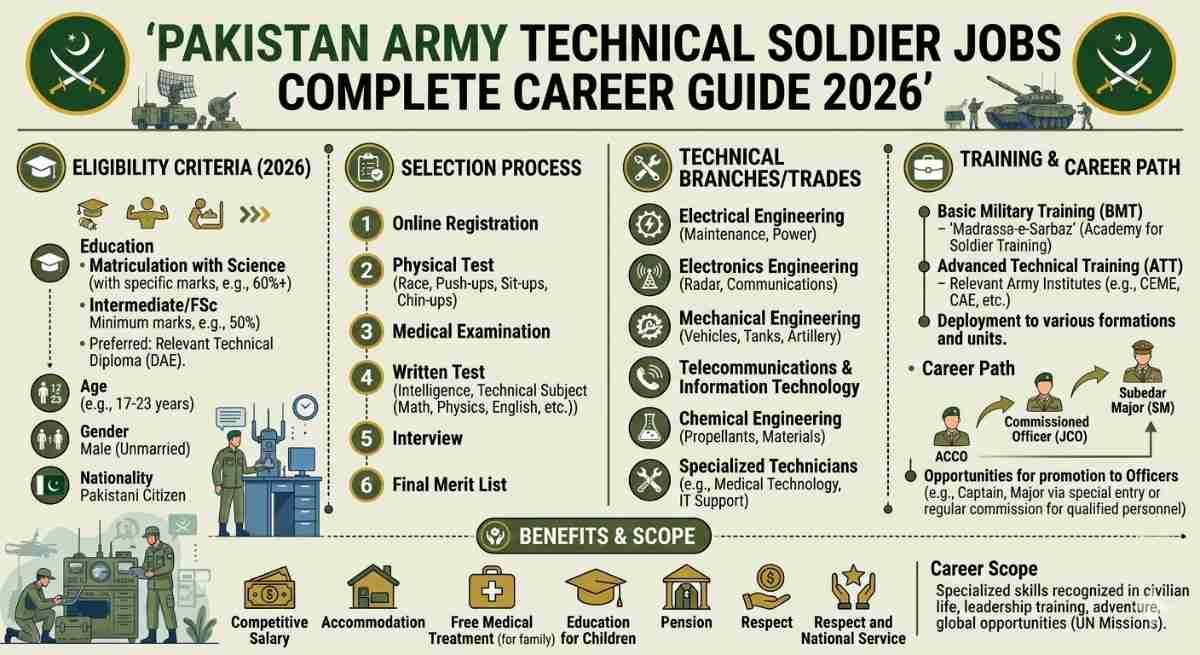
When you apply as a technical soldier, you’re applying for a specific trade. Here are the main categories:
Vehicle Mechanic is one of the most common and consistently recruited trades. You maintain and repair military vehicles ranging from jeeps to heavy transport trucks to armored carriers. The civilian transferability of this skill is excellent.
Electrician trades cover maintenance of electrical systems across military installations and vehicles. Generators, wiring systems, and vehicle electrical components. Qualified electricians from the Army find immediate civilian employment after service.
Fitter trades involve mechanical fitting, maintenance, and repair of weapons systems, machinery, and equipment. Precision work that requires focus and technical aptitude.
Radio Operator and Communication Technician roles fall under the Corps of Signals. You operate and maintain communication systems, radio equipment, and increasingly digital communication infrastructure.
Medical Assistant and Nursing Assistant roles are part of the Army Medical Corps. You assist in military hospitals and field medical units, gaining healthcare experience that transfers directly to civilian medical careers.
Cook, Tailor, and Mess Staff are sometimes overlooked but are legitimate technical soldier categories with consistent recruitment.
Computer Operator and IT-related trades have grown significantly as the Army modernizes its administrative and operational systems. If you have an IT background, this category is worth targeting specifically.
Eligibility Criteria You Need to Know
Before anything else, check whether you actually meet the basic requirements. Going through the application process without confirming eligibility is a waste of time for everyone.
Age requirements for technical soldier recruitment typically fall between 17 and 23 years. Some specialized trades may have slightly different age brackets so always verify against the specific recruitment advertisement.
Educational requirements are where technical soldiers differ from general duty soldiers. Most technical trades require a minimum of Matric with science subjects. Some trades, particularly in communication, IT, and medical categories, prefer intermediate or a relevant technical diploma from a TEVTA-recognized institution.
Physical standards include a minimum height of 5 feet 4 inches for most categories, though some corps have slightly different requirements. Weight must be proportional. Eyesight standards are checked carefully and differ by trade. Drivers and certain technical roles have specific vision requirements.
Domicile is important. Recruitment quotas are allocated by province and district. Your domicile certificate must match your actual registered district. This trips up many applicants who have been living in a different city for years but haven’t updated their documentation.
A clean character certificate from your local police station is required. Any criminal record, even minor issues, can result in disqualification.
The Application and Selection Process Step by Step
Step one is watching for official recruitment advertisements. The Pakistan Army announces recruitment through its official website, joinpakarmy.gov.pk, through the Inter Services Public Relations, and through major Urdu and English newspapers. Recruitment seasons typically happen once or twice a year. Set reminders and check regularly rather than relying on someone else to tell you.
Step two is online registration. Go to joinpakarmy.gov.pk and complete your registration during the open window. Fill every field accurately. Upload clear scans of your documents. Errors in this step cause problems at every subsequent stage.
Step three is the initial written test. Candidates are called to regional recruitment centers for a written assessment covering general knowledge, basic math, Urdu, English, and sometimes trade-relevant questions. The difficulty level is manageable if you prepare. Past paper collections specifically for Pakistan Army recruitment are available at book stalls in most cities and on several Pakistani educational websites.
Step four is the physical fitness test. This includes a distance run, push-ups, sit-ups, and chin-ups. The standards are serious. Start physical preparation at least two to three months before you expect to appear. Running is the most eliminating component for unprepared candidates.
Step five is the medical examination conducted at the Army Selection and Recruitment Centre. Be completely honest about any medical history. Attempting to hide conditions leads to permanent disqualification if discovered, which is far worse than being deferred for a treatable issue.
Step six is the trade test for technical categories. This practical assessment evaluates whether you actually have the baseline knowledge your educational certificates claim. If you have a matric in science subjects, you should be able to answer basic questions relevant to your applied trade. Brush up on fundamentals.
Step seven is the final interview and psychological assessment. Officers evaluate your motivation, communication, and overall suitability. Be direct and genuine. They are looking for candidates who are serious about service, not those who memorized scripted answers.
Training After Selection
Selected candidates go through initial military training at recruit centers. This phase builds physical fitness, military discipline, and basic soldiering skills across all categories.
After initial training, technical soldiers proceed to their corps-specific training centers. A vehicle mechanic goes to the EME training school. A signals soldier goes to the School of Signals. A medical assistant goes to the Army Medical Corps training facility. This phase is where the actual trade training happens, and it can last from several months to over a year depending on the complexity of the trade.
My uncle spent 14 months in technical training before he was posted to his first unit. He found it exhausting but said the instructors were genuinely knowledgeable and the training was practical rather than theoretical.
Salary and Benefits That People Often Underestimate
A newly inducted technical soldier earns basic pay that seems modest at first glance, starting around Rs. 25,000 to Rs. 35,000 per month at entry level. But the total compensation picture is very different from that number alone.
Free housing in military accommodation or house rent allowance. Free medical treatment for yourself and your immediate family at military hospitals. Free rations or ration allowance. Subsidized shopping at canteen stores. Educational facilities for children at Army Public Schools with heavily subsidized fees.
Promotion-linked pay increases are structured and predictable. As you move from Sipahi to Lance Naik, Naik, Havaldar, and eventually Subedar, salary increases substantially at each grade.
After completing service, the retirement package includes a monthly pension for life, gratuity, and in many cases access to residential plots through military housing schemes. The long-term financial security this provides is genuinely difficult to match in most civilian careers at the same educational entry level.
Common Mistakes That Eliminate Candidates
Applying with incorrect domicile documentation is the most avoidable disqualification. Verify your domicile is from your registered district and that it is currently valid before you do anything else.
Ignoring physical preparation until the last moment eliminates a surprising number of otherwise qualified candidates. The fitness test is standardized and unforgiving. Treat your physical preparation as seriously as your written test preparation.
Providing inaccurate information anywhere in the process is career-ending in military recruitment. If something in your history is complicated, address it honestly rather than hoping it won’t be checked.
Applying for a trade you have no background in, hoping to figure it out later, creates problems at the trade test stage. Apply for trades that align with your actual educational background and interests.
Relying on touts or middlemen who claim they can arrange selection is both wasteful and dangerous. Pakistan Army recruitment has become increasingly merit-based and transparent. These individuals take money and deliver nothing while potentially creating legal problems for you.
Life After Military Service
This is the part my uncle talks about most. After retirement, his EME background meant civilian companies in the automotive and heavy machinery sector were interested in him immediately. He spent five years working as a maintenance supervisor at a private firm before fully retiring. The skill never expired.
Technical soldiers from signals backgrounds move into telecom companies. Medical assistants join private hospitals and clinics. IT trade soldiers move into corporate IT support roles. The Army essentially provides funded technical training and then a career, and when that career concludes, it leaves you with certified, experienced skills that the civilian market respects.
For a young person in 2026 weighing career options, the Pakistan Army technical soldier path offers something increasingly rare: genuine training, structured growth, financial security, and a skill set that travels with you for life.