There is a particular kind of respect that follows Military Police soldiers wherever they go inside military installations. I noticed it the first time I visited a cantonment with my father, who was meeting an old colleague. The MP soldier at the gate had this composed, sharp presence that was different from what I expected. He was not just standing there. He was observing everything, managing vehicle flow, checking credentials, and doing all of it with a quiet authority that made people take him seriously without him raising his voice once.
I asked my father about it on the drive back. He explained that Military Police are not ordinary soldiers. They are the internal law enforcement of the Army. Selected more carefully, trained more specifically, and held to a higher standard of conduct than most other soldier categories.
That conversation stayed with me. And years later, when younger relatives started asking about Army careers, the Military Police category kept coming up as something genuinely worth understanding properly. So here is everything that actually matters about MP soldier jobs in Pakistan heading into 2026.
What Military Police Soldiers Actually Do
Most people have a vague idea that Military Police handle discipline inside the Army. That is true but it only covers part of the picture.
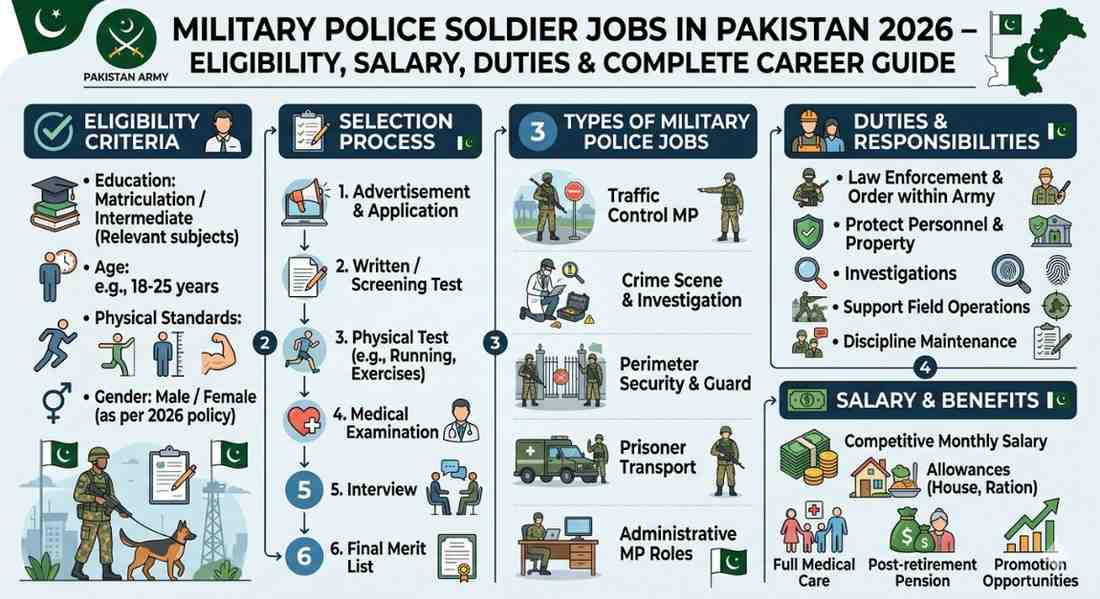
MP soldiers manage entry and exit at cantonment gates and military installations. They check credentials, control vehicle access, and ensure that only authorized personnel enter sensitive areas. This sounds routine, but it requires constant alertness and sound judgment, especially in high-security environments.
Traffic management inside cantonment areas and during military convoys is another core responsibility. Military vehicles, civilian staff, and visitors all move through cantonment roads, and MP soldiers keep that movement organized and safe.
Prisoner escort and handling falls within MP jurisdiction. When military personnel face disciplinary proceedings or detention, MP soldiers are responsible for custody and transportation.
VIP protection and escort duties are assigned to MP units when senior military officials or visiting dignitaries move through cantonment areas. This requires a higher level of preparation and situational awareness.
Crime investigation within military premises, in coordination with the Army’s legal and judicial system, involves MP soldiers collecting information, managing scenes, and supporting formal proceedings.
Ceremonial duties at military events, parades, and formal occasions are also part of the role. MP soldiers are frequently visible at high-profile military functions precisely because their presentation and discipline are consistently maintained.
The work combines law enforcement, security, administration, and ceremonial functions in a way that keeps the role varied and demanding.
Why MP Is Considered a Prestige Posting Among Soldiers
Within Army culture, getting selected for the Corps of Military Police carries a certain weight. The physical and character standards for MP are higher than general duty soldier recruitment. Not everyone who applies for Army service gets routed to MP. Selection into this corps signals that you met a more demanding bar.
MP soldiers also develop skills that have real value beyond military service. Crowd management, security protocols, conflict de-escalation, documentation of incidents, and maintaining authority under pressure are capabilities that private security companies, corporate security departments, and law enforcement adjacent organizations actively look for in retired military personnel.
My father’s colleague, who spent 15 years in the MP corps, retired and was immediately picked up by a private security firm handling corporate clients in Karachi at a salary that surprised everyone who heard about it. His MP background was the direct reason he was hired over other candidates.
Eligibility Criteria for MP Soldier Recruitment in 2026
Age requirement for MP soldier recruitment is typically between 17 and 23 years. Verify this against the specific recruitment notification when it is released because batch requirements occasionally vary slightly.
Educational qualification required is a minimum Matric, meaning a Secondary School Certificate. Some MP recruitment batches prefer candidates with intermediate level education, particularly where administrative or documentation duties are emphasized. Science subjects at matric level are sometimes preferred but not always mandatory.
The height requirement for Military Police is notably stricter than some other soldier categories. The minimum height is generally 5 feet 6 inches and in some batches 5 feet 7 inches. This is higher than the general infantry minimum and reflects the presentational and physical demands of the MP role.
Weight must be proportional to height within Army standards. Neither underweight nor overweight candidates clear the medical examination.
Eyesight standards for MP are specific. Certain vision requirements must be met without glasses for most MP duties given the nature of security and observation work. Check current vision standards carefully if this is a concern before investing time in the application process.
Physical fitness must be above average. The fitness test for MP candidates is evaluated with the understanding that the role requires sustained physical capability, not just passing a minimum threshold.
Character requirements are taken more seriously for MP than many other categories. A clean background with no criminal record or family history of legal issues is essential. Character verification is conducted thoroughly.
Domicile must be from your registered district and must be current and valid. Recruitment quotas are allocated regionally, and your domicile determines which quota you compete within.
The Selection Process Step by Step
Step one is monitoring official recruitment announcements. The joinpakarmy.gov.pk website is the only reliable source for official recruitment notifications. ISPR official social media accounts and major newspapers including Jang, Dawn, and The News also carry announcements. Set reminders to check regularly because windows open and close on fixed schedules.
Step two is completing online registration at joinpakarmy.gov.pk during the active window. Fill every field accurately. Upload clean, properly formatted scans of your documents. Any discrepancy between your submitted information and your original documents creates problems at verification stages.
Step three is the written test at a regional recruitment center. The assessment covers general knowledge, English, Urdu, and basic mathematics. The standard is manageable with preparation. Past papers for Pakistan Army written tests are available at book stalls in major cities and on several Pakistani educational websites. Practice specifically rather than relying on general knowledge alone.
Step four is the physical fitness test. This includes a distance run, push-ups, sit-ups, and chin-ups. For MP specifically, physical standards are applied seriously. Begin physical preparation at minimum two to three months before your expected test date. Run regularly, build upper body strength progressively, and arrive on the test day already conditioned rather than hoping adrenaline carries you through.
Step five is the medical examination conducted at the Army Selection and Recruitment Centre. Be completely honest about any medical history. Attempting to conceal conditions and having them discovered during examination results in permanent disqualification, which is irreversible. A deferral for a treatable condition is a far better outcome than permanent barring.
Step six is the interview and character assessment. Officers on the panel assess your communication, confidence, motivation, and overall suitability for the MP role specifically. Be direct and genuine. Demonstrate that you understand what the MP corps does and that you are pursuing it deliberately rather than just taking whatever Army category is available.
Step seven is background verification. For MP, this step is more thorough than most other categories. Family background, character references, and local police records are all reviewed. This is standard and expected. There is nothing to do here except ensure your submitted information is accurate.
Training After Selection
Selected MP soldiers complete basic military training at a recruit center covering discipline, physical conditioning, drill, weapons familiarization, and general soldiering. This phase is shared with recruits across other corps.
After basic training, MP soldiers proceed to specialized Corps of Military Police training. This covers law enforcement procedures within military jurisdiction, custody and escort protocols, traffic management, checkpoint operations, documentation of incidents, and the specific authority and limitations of MP personnel under military law.
The specialized training phase prepares recruits for their actual duties rather than just military basics. By the end of this phase, a new MP soldier understands not just how to march and handle a weapon but how to manage a checkpoint, handle a difficult situation at a cantonment gate, and conduct themselves with the composure the role requires.
Salary and Benefits in Real Terms
Entry-level salary for a newly inducted sipahi in the MP corps follows standard Army soldier pay scales, starting in the range of Rs. 25,000 to Rs. 35,000 in basic pay. This number does not represent the complete picture.
Free accommodation within military quarters or house rent allowance where quarters are unavailable. Free medical treatment at military hospitals for the soldier and immediate family. Ration allowance. Access to canteen stores at subsidized prices. Army Public Schools for children at heavily reduced fees.
As rank progresses from Sipahi through Lance Naik, Naik, Havaldar, and into JCO grades, salary increases are structured and predictable at each promotion. Long-serving MP soldiers who reach JCO level earn significantly more than their entry point and carry considerable authority within the corps.
Post-retirement benefits, including monthly pension for life, gratuity, and access to military welfare housing schemes, provide long-term financial security that makes the complete career compensation package substantially more valuable than the starting salary suggests.
Mistakes That Eliminate Candidates Before They Get Started
Applying without meeting the height requirement is the most straightforward disqualification. Measure accurately before applying. If you are below the minimum, this particular category is not the right fit regardless of how strong your other qualifications are.
Ignoring physical preparation because the application process feels far away is a mistake that eliminates otherwise qualified candidates at the fitness test. Start running and training the day you decide to apply, not the week before the test.
Using incorrect or outdated domicile documentation creates avoidable problems. Confirm your domicile is valid and from your registered district before submitting anything.
Gathering information from unofficial sources, including social media groups and YouTube channels that recycle old recruitment details, leads to confusion about current requirements, deadlines, and procedures. Use only joinpakarmy.gov.pk for current information.
Attempting to influence the selection process through contacts or agents is both ineffective and risky. MP recruitment specifically tends to be conducted with attention to character and integrity because those are core requirements of the role itself.
What This Career Looks Like Over Time
The Military Police career path rewards consistency and professionalism more visibly than some other soldier categories because the role itself is so closely tied to conduct and discipline. Soldiers who maintain high standards, take their duties seriously, and perform reliably move through ranks at a steady pace.
The skills built over an MP career- security management, authority under pressure, documentation, protocol, and professional conduct- translate into strong post-retirement opportunities in private security, corporate security management, and various government-adjacent roles.
For someone in 2026 who wants military service with a structured, indoor and outdoor mixed role, higher selection standards that signal genuine achievement, and skills that carry real value for life after service, the Military Police Corps is one of the most worthwhile paths available in the Pakistan Army.