My mother’s cousin came to visit us from a small village near Chakwal about four years ago. He had finished his matric, was a decent cook because he had helped in his family’s small dhaba since he was twelve, and had absolutely no idea what to do with his life next. He was one of those people who had practical skills but no clear path to turn them into something stable.
Someone at a local recruitment awareness camp told him about Army cook recruitment. He almost dismissed it. In his head, the Army meant fighting, physical danger, and a life completely disconnected from anything he knew. When he found out that the Army actively recruits trained cooks as regular soldiers with full military benefits, he could not quite believe it.
He applied. He got selected. He is now in his third year of service, posted at a unit mess in Kharian, earning a steady income with free housing and free medical for his parents back home. He calls his mother every Sunday and sounds genuinely settled in a way that surprises everyone who knew him before.
The Army cook category is one of the most underestimated entry points into military service in Pakistan. It rewards a skill that millions of people already have, provides full soldier status with every benefit that comes with it, and opens a career path that many people from rural and semi-urban backgrounds genuinely never considered.
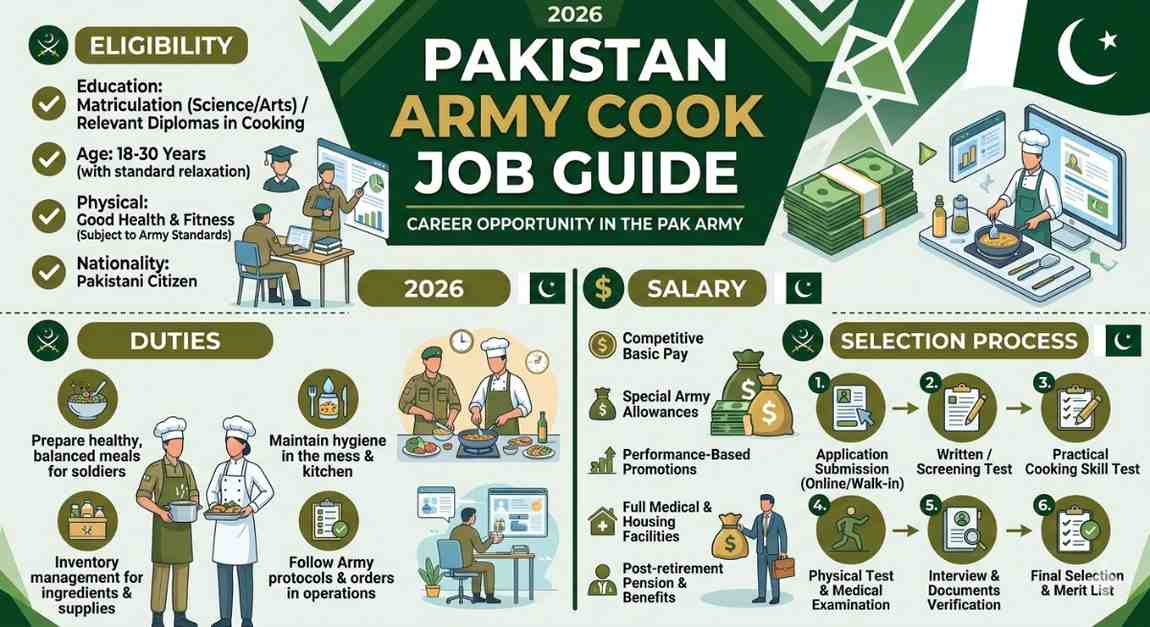
What an Army Cook Actually Does
The mess system is central to military unit life. Soldiers need to eat three times a day, every single day, regardless of what else is happening. Army cooks make that happen.
At the unit level, cooks work in military messes preparing meals for soldiers, NCOs, and officers separately since military messes are organised by rank. The scale of cooking is significant. You are not preparing a family dinner. You are managing meals for dozens to hundreds of people simultaneously, consistently, and to nutritional and hygiene standards that the Army takes seriously.
Menu planning based on available rations is part of the work. The Army Supply Corps provides ingredients, and cooks work within those provisions to prepare balanced meals. Understanding quantities, managing cooking times at scale, and maintaining hygiene in a professional kitchen environment are daily requirements.
During field exercises and deployments, field cooking under challenging conditions becomes the reality. Portable cooking equipment, limited ingredients, outdoor environments, and maintaining food safety while feeding a unit in the field is genuinely demanding work that requires both skill and composure.
Special events including formal dinners, visiting dignitary meals, and ceremonial occasions require elevated cooking standards. Army cooks assigned to officer messes especially develop skills in formal cuisine preparation that go well beyond basic cooking.
Mess management and inventory also fall within the cook’s responsibilities. Tracking rations, reporting shortages, maintaining kitchen cleanliness, and ensuring equipment is properly maintained are administrative dimensions of the role.
Why This Career Makes More Sense Than People Initially Think
When my mother’s cousin first told his friends he was joining the Army as a cook, a few of them laughed. Within a year, those same friends were asking him how to apply.
The reason is simple. Army cook is a full soldier position. Not a civilian kitchen worker, not a contractor. A soldier with military service records, military rank progression, military pension, military medical benefits, and all the respect and security that comes with proper Army service.
The skill being evaluated at entry is one many people from cooking backgrounds already possess to some degree. That lowers the barrier to entry compared to highly technical trades while still leading to the same career structure and benefits package.
For families from smaller cities, towns, and villages where someone has grown up around cooking whether at home, at a dhaba, or at a small restaurant, this category represents a genuine and realistic path into organised military service.
Eligibility Criteria for Army Cook Recruitment
Age requirement is typically between 17 and 23 years at the time of application. Some recruitment batches have slight variations, so always verify against the specific official advertisement.
The educational qualification required is minimum primary school completion, meaning class five pass, for the basic cook category. Some batches require middle school, meaning class eight pass. This is one of the lower educational barriers in Army soldier recruitment, which makes it accessible to a wider range of candidates.
Physical standards apply fully even though this is a non-combat role. Minimum height of 5 feet 4 inches is typical. Weight must be proportional. Medical fitness is evaluated at the recruitment centre. Eyesight, hearing, flat feet, and general physical health are all examined.
Basic cooking knowledge is assessed during the selection process. You do not need formal culinary training, but demonstrating that you can actually cook, handle kitchen equipment, and understand basic food preparation will be evaluated. Someone with a dhaba background, home cooking experience, or any practical kitchen exposure has an advantage here.
Domicile from your registered district is required. Regional recruitment quotas apply, and your domicile determines which pool you compete within.
Clean character with no criminal record is required across all Army recruitment categories. A character certificate from your local police station is part of the documentation process.
The Selection Process Step by Step
Step one is finding official recruitment announcements. Check joinpakarmy.gov.pk regularly. Cook category recruitment is advertised through the same channels as other soldier recruitment, including ISPR official accounts and major newspapers. Do not rely on forwarded WhatsApp messages or social media posts from unofficial pages as these frequently contain outdated or incorrect details.
Step two is completing your online registration at joinpakarmy.gov.pk during the active window. Enter all information accurately. Upload clean document scans. Any discrepancy between your submitted information and original documents creates complications at later stages.
Step three is gathering your documents before the window opens so you are not scrambling once recruitment is announced. You will need your CNIC or Form B if under 18, domicile certificate, educational certificates, character certificate from local police, and recent photographs. Have all of these attested and organised in advance.
Step four is the written test at a regional recruitment centre. The assessment covers general knowledge, basic Urdu, and simple mathematics. Given the lower educational entry requirement for the cook category, the written test is calibrated accordingly. Prepare using available past paper collections specifically for Pakistan Army recruitment tests.
Step five is the physical fitness test. Running, push-ups, sit-ups, and chin-ups are standard components. Physical standards apply equally to cook candidates as to other soldier categories. Start training at least two months before your expected test date. Running fitness is where most unprepared candidates struggle. Train specifically to the known distance and time requirements.
Step six is the practical cooking assessment. This is specific to the cook category and is where your actual kitchen experience is evaluated. You may be asked to prepare specific dishes, demonstrate knife skills, show understanding of cooking techniques, or answer questions about food preparation. Practice cooking deliberately in the weeks before your selection date. Focus on cleanliness, organisation, and basic techniques rather than elaborate recipes.
Step seven is the medical examination at the Army Selection and Recruitment Centre. Be completely honest about any medical history. Concealing conditions and having them discovered results in permanent disqualification. A temporary deferral for something treatable is recoverable. Permanent disqualification is not.
Step eight is the interview. Panel officers assess your motivation, communication, and overall suitability. Speak clearly about your cooking background, your reasons for wanting to join, and your understanding of what the role involves. Demonstrating genuine familiarity with cooking rather than treating it as just a job label helps significantly.
Training After Selection
Selected cook recruits complete standard basic military training alongside recruits from other categories. This covers military discipline, drill, physical conditioning, basic weapons familiarisation, and general soldiering. You are a soldier first and a cook second within the Army’s framework.
After basic training, cook soldiers receive specialised training in military mess management, large-scale food preparation, field cooking procedures, military hygiene and food safety standards, and ration management. This professional kitchen training within a military context prepares recruits for the specific demands of Army mess work rather than civilian restaurant work.
The training period is where recruits from dhaba backgrounds often discover how much they already know and how much more there is to learn about professional-scale cooking. My mother’s cousin said the field cooking training surprised him most because the conditions were so different from anything he had experienced before.
Salary and Benefits Package
Basic pay for a newly inducted Army cook starts in the range of Rs. 25,000 to Rs. 35,000 per month, following standard soldier pay scales. The headline salary number consistently undersells the complete compensation picture.
Free accommodation in military quarters or house rent allowance where quarters are not provided. Free medical treatment at military hospitals for the soldier and immediate family, including parents in some welfare schemes. Ration allowance. Access to canteen stores at subsidised prices for daily essentials. Army Public Schools for children at heavily reduced fee rates.
Rank progression from Sipahi through Lance Naik, Naik, Havaldar, and into JCO grades brings structured salary increases at each promotion. A cook who serves consistently and performs well advances through these grades over a career, and the corresponding salary growth is significant.
Post-retirement benefits including monthly pension for life, gratuity payment, and access to military welfare housing schemes through the Fauji Foundation and Army Welfare Trust represent the long-term security that makes a full Army career genuinely valuable far beyond what starting pay suggests.
Mistakes That Cost Applicants Their Chance
Arriving at the practical cooking assessment with no recent kitchen practice is the most specific mistake for this category. If you have a cooking background but have not actually been cooking recently, spend deliberate time in the kitchen in the weeks before your selection. Rusty skills show clearly under evaluation conditions.
Treating the physical test as less important because the role is kitchen-based is a consistent mistake. The Army applies physical standards uniformly. Arrive physically prepared regardless of what position you have applied for.
Submitting applications with incomplete or incorrectly attested documents causes immediate disqualification. Prepare and verify every document requirement before submitting anything.
Relying on unofficial information about recruitment dates, requirements, and procedures from social media creates confusion and missed opportunities. Use only the official joinpakarmy.gov.pk website for reliable current information.
Approaching agents or touts claiming to facilitate selection is both a waste of money and a risk to your application. Army recruitment has clear merit-based procedures and no legitimate shortcut exists.
Looking at the Bigger Picture
My mother’s cousin does not talk about his job as just cooking anymore. He talks about his unit, his colleagues, his postings, his plans for promotion. The cooking is the entry point, but the life he has built around it is much larger than the mess kitchen.
For someone in 2026 with practical cooking skills and a desire for stable, respected, long-term employment, the Pakistan Army cook category offers something genuinely rare: a career that starts with what you already know and builds into something that provides security for decades. The people who find out about this path and take it seriously consistently end up in a better position than those who overlooked it while waiting for something that seemed more prestigious on the surface.