My childhood friend Tariq wanted to join the police since he was about fourteen years old. Not for glamorous reasons, not because of some television drama. His older sister had faced a genuinely difficult situation involving property fraud, and the family spent two years navigating a system that felt completely indifferent to them. He watched his father leave the police station defeated more times than he could count and decided quietly that he wanted to be on the other side of that desk someday, actually helping people rather than turning them away.
He studied consistently, stayed physically active, and appeared in the Punjab Public Service Commission test for Sub-Inspector when he was 24. He cleared it. He is now posted in Lahore, and while he will tell you honestly that the job is harder and more complicated than he imagined, he will also tell you it is exactly where he is supposed to be.
Sub-Inspector is one of the most meaningful entry points into the Pakistan Police service. It sits at a level where you have real authority, real responsibility, and genuine daily impact on people’s lives. Understanding this career properly before pursuing it makes a significant difference in how well you prepare and what you actually experience once you are in.
What a Sub-Inspector Actually Does Every Day
The SI rank sits between the constable level and the Inspector level in the police hierarchy. In practical terms, this means you are senior enough to lead investigations and junior enough to still be deeply involved in frontline work. It is an active, hands-on position rather than an administrative one.
Station House Officer responsibilities frequently fall on Sub-Inspectors, particularly in smaller police stations or where Inspector-level officers are managing multiple responsibilities. As SHO you oversee the entire operation of a police station, manage the daily register, supervise constables, handle incoming complaints, and ensure the station functions properly.
Investigation work is central to the SI role. When a case is registered at your station you are often the officer who conducts the actual investigation. Recording statements from complainants and witnesses, visiting crime scenes, collecting and preserving evidence, coordinating with forensic teams, and preparing charge sheets for court submission all fall within your responsibilities.
Patrolling and maintaining law and order in your jurisdiction is ongoing. Monitoring sensitive locations, managing crowds during events or sensitive periods, and coordinating rapid response to incidents require both planning and presence on the ground.
Court appearances are a significant and often underestimated part of the job. An SI spends considerable time presenting evidence before magistrates and session courts, responding to defence questions, and maintaining the chain of custody documentation that makes prosecutions legally sound. Weak documentation by investigators is one of the most common reasons criminal cases collapse in Pakistani courts.
The Rank’s Position in the Police Structure
Understanding where SI sits in the hierarchy helps you understand both the authority and the pressures of the role.
Above the SI level are Inspectors, Deputy Superintendents of Police, Superintendents, and higher ranks in the gazetted officer category. Below are Assistant Sub-Inspectors, Head Constables, and Constables.
The SI rank is the lowest level of what is considered officer-grade responsibility in many operational contexts, which means it carries genuine authority while also carrying genuine accountability. When something goes wrong in an investigation or at a station, the SI is often the officer who must answer for it.
This accountability is not a reason to avoid the role. It is a reason to understand it clearly before entering it.
Eligibility Criteria by Province
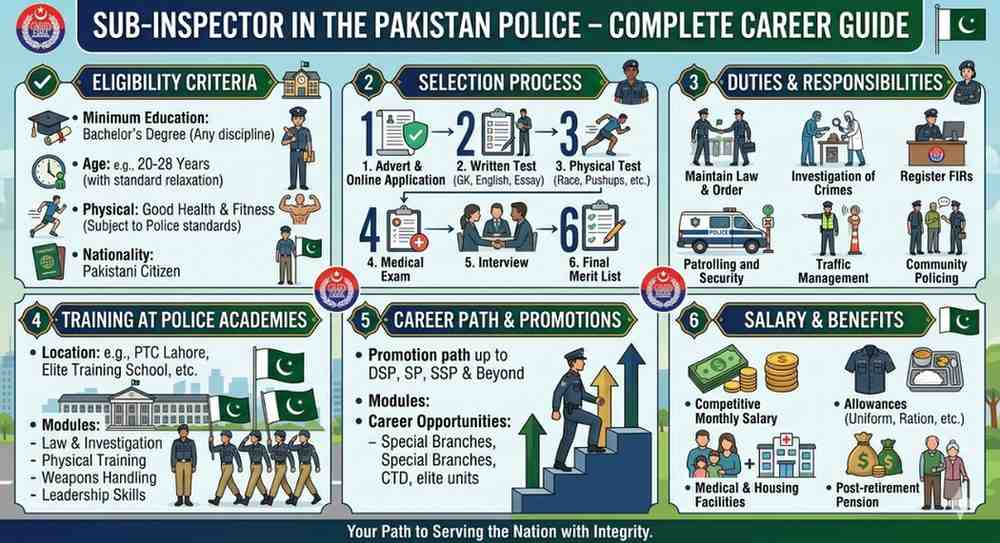
Pakistan Police is a provincial subject, meaning each province conducts its own recruitment through its respective Public Service Commission. Requirements vary somewhat between Punjab, Sindh, KPK, and Balochistan, but the core criteria are consistent.
The educational qualification required is a bachelor’s degree from an HEC-recognized university for direct recruitment as Sub-Inspector. The degree can be in any discipline. Unlike some government positions there is no preferred subject area for general SI recruitment, though law, criminology, and social sciences provide relevant background knowledge that helps once you are in the role.
Age limit is typically between 20 and 28 years for open merit candidates. Age relaxations apply for government servants already in service, candidates from specific regions, and in some batches for women candidates. Always verify the exact age limits from the current official advertisement since provincial rules differ and batches occasionally have specific conditions.
Physical standards are taken seriously for police recruitment. Minimum height for male candidates is generally 5 feet 7 inches in Punjab, and similar requirements apply in other provinces with minor variations. Female candidates have separate height requirements. Weight must be proportional. Chest measurement requirements apply in some provinces for male candidates.
Physical fitness test standards include a measured distance run, push-ups, and sometimes additional components depending on provincial requirements. These are competitive rather than minimal standards and require real preparation.
Medical fitness covers eyesight, hearing, flat feet, cardiovascular health, and general physical condition. Certain conditions that would prevent active field duty result in medical disqualification.
Domicile requirements apply. Each province recruits primarily from its own domicile holders. District-level quotas may also apply within provinces. Your domicile certificate must be current, valid, and from your registered district.
The Selection Process Step by Step
Step one is monitoring your provincial Public Service Commission website. PPSC for Punjab at ppsc. gop.pk, SPSC for Sindh, KPPSC for Khyber Pakhtunkhwa, and BPSC for Balochistan all post recruitment advertisements on their official websites. Register on the relevant commission’s portal and check regularly. Advertisements also appear in major provincial newspapers.
Step two is submitting your online application within the specified window. Pay the application processing fee through the designated method. Keep all payment receipts and application confirmation documents safely because you will need them at every subsequent stage.
Step three is the written examination conducted by the Provincial Public Service Commission. The examination typically covers English essay and comprehension, general knowledge and current affairs, Pakistan studies, Islamic studies, everyday science, and basic mathematics. The competitive standard requires months of systematic preparation rather than casual revision.
For current affairs and general knowledge, reading Dawn and The News consistently over several months builds genuine knowledge that serves you in the examination and throughout your career. For Pakistan studies and constitutional matters, standard PSC preparation guides available at major bookshops in every city are the practical starting point. For English, regular practice writing essays and precis is essential since these components carry significant marks.
Past papers from your provincial PSC are valuable preparation tools. They reveal examination patterns, frequently tested topics, and the expected depth of answer. Several publishers produce past paper compilations specifically for provincial police SI examinations, and these are worth obtaining.
Step four is the physical fitness test for candidates who clear the written examination. Running is typically the most eliminating component for unprepared candidates. Begin physical training from the day you decide to apply, not after you see your written test result. By the time your physical test date arrives, you should have been training consistently for months.
Step five is the psychological assessment conducted in some provincial recruitment processes. This evaluates your temperament, stress response, decision-making patterns, and general suitability for law enforcement work. Approach it honestly rather than trying to present a calculated version of yourself. Trained assessors recognise performance anxiety from genuine personality characteristics.
Step six is the medical examination at a designated government medical facility. Complete transparency about your medical history is essential. Conditions discovered after joining that were concealed during selection create grounds for termination, which is a far worse outcome than a deferred application.
Step seven is the detailed character and background verification. Family background, financial history, criminal record, and local character references are all reviewed. This process takes time and is thorough. Ensure everything you have submitted throughout the process is accurate and consistent.
Step eight is the final merit list publication and appointment letter issuance. This is followed by mandatory training at a provincial police training college.
Training After Selection
Selected Sub-Inspectors attend provincial police training colleges for an initial training period that typically lasts around six months to a year depending on the province and the specific batch requirements.
Training covers criminal law and the Criminal Procedure Code, police rules and regulations, investigation techniques and evidence handling, first aid and emergency response, physical training and self-defence, firearms handling and safety, human rights and legal boundaries of police authority, and report and documentation writing.
The training period includes examinations, and candidates who do not meet academic standards during training can face setbacks. Treat the training phase as a continuation of your preparation rather than a formality after selection.
Field attachment during training places probationary SIs in working police stations under supervision, which is where the gap between classroom knowledge and actual police work becomes immediately apparent. Pay close attention during this phase because the practical lessons learned here shape how you work for years afterwards.
Salary and Benefits
Sub-Inspector falls in the BPS-14 category in Punjab and similar grades in other provinces. Current basic pay at this grade ranges from approximately Rs. 45,000 to Rs. 60,000 per month depending on the province and current pay revision status.
House rent allowance where government accommodation is not provided, medical allowance, and various duty allowances apply. Police officers posted in specific areas or assigned to specialised units receive additional allowances relevant to those postings.
Promotion progression from Sub-Inspector moves through Inspector, Deputy Superintendent, and upward through departmental promotion examinations and seniority. Each promotion brings a salary increase and expanded authority. Officers who demonstrate consistent performance and clear promotion examinations can advance meaningfully over a full career.
Provincial police officers also receive a pension after completing qualifying service, provident fund contributions, gratuity, and access to police welfare facilities including hospitals and educational institutions in some provinces.
Mistakes That Eliminate Strong Candidates
Beginning physical preparation too late is the most consistent mistake among otherwise qualified candidates. The physical test eliminates a substantial percentage of applicants. If you are starting preparation today, start running today.
Inconsistency across submitted documents creates verification problems. Your name spelling, date of birth, domicile details, and educational information must be perfectly consistent across every document you submit throughout the entire process.
Underestimating the written examination because it covers general rather than specialised subjects leads to poor performance. General knowledge examinations are competitive precisely because everyone takes them and the differentiation happens through depth and breadth of preparation.
Attempting to use intermediaries or connections to influence selection outcomes is both ineffective in increasingly merit-based processes and legally risky. Prepare on your merit and apply through proper channels.
Entering the career with unrealistic expectations about the working environment creates early disillusionment. The Pakistan Police operates within a system that has genuine challenges. Officers who understand this reality before joining and enter with patience and long-term commitment tend to do far better than those who expected something different.
What This Career Honestly Looks Like
Tariq told me something interesting last year. He said the hardest part of the job is not the difficult cases or the physical demands. It is maintaining your own standards consistently within a system that does not always reward integrity immediately. He said the officers who last and genuinely contribute are the ones who decided early what kind of officer they were going to be and did not negotiate on that.
Sub-Inspector in the Pakistan Police is a career that will challenge you in ways most jobs do not. It will also give you the kind of direct positive impact on people’s lives that most careers never offer. For the right person with the right preparation and genuine motivation, it is one of the most worthwhile public service careers available in Pakistan in 2026.