When my senior from university told me he had gotten a job at the Ministry of Defence, my first reaction was confusion. I genuinely did not understand how a civilian with a commerce degree ended up working for what I assumed was a purely military institution. I pictured uniformed generals and weapons procurement, not accountants and clerks and IT staff working in government offices.
He laughed and explained it properly. The Ministry of Defence is a federal civilian government ministry like any other. Yes, it oversees Pakistan’s defence establishment, but the ministry itself employs thousands of civilian officials across administrative, financial, technical, legal, and support functions. His job involved budget documentation and financial record maintenance. He wore shalwar kameez to work, not a uniform.
That conversation completely changed how I understood this institution and honestly opened my eyes to one of the most stable and underappreciated employment categories in Pakistan’s federal government.
If you are researching Ministry of Defence jobs for 2026, here is a complete picture of what this career path actually involves.
Understanding What the Ministry of Defence Actually Is
The Ministry of Defence in Pakistan is the federal cabinet ministry responsible for policy coordination, budget oversight, and administrative supervision of the country’s defence establishment. It works with the three armed services, defence production organisations, various attached departments, and affiliated bodies.
The ministry is headquartered in Islamabad and operates through a structure of secretaries, joint secretaries, deputy secretaries, section officers, and supporting staff across multiple wings covering different functional areas.
Critically for anyone considering employment here, the ministry employs a large civilian workforce. These are not military positions. They are federal government civil service roles governed by civil service rules and Basic Pay Scales, the same framework used across all federal ministries.
The attached departments and organisations under the Ministry of Defence umbrella add significantly to the employment picture. Entities like the Defence Housing Authority, Fauji Foundation, Pakistan Ordnance Factories, Pakistan Aeronautical Complex, and various other defence-linked organisations all have their own civilian staffing requirements that collectively represent thousands of employment positions across the country.
Categories of Jobs Available in 2026
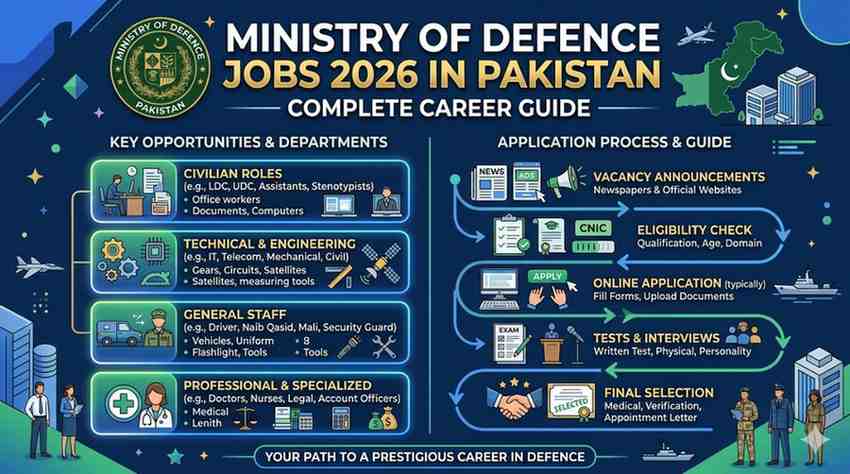
The range of positions under the Ministry of Defence umbrella is broader than most people expect.
Administrative and Clerical Staff covers positions from lower division clerk through upper division clerk, assistant, private secretary, and section officer levels. These roles handle correspondence, file management, record maintenance, official documentation, and the day-to-day administrative functioning of ministry offices. Educational requirements range from intermediate for basic clerical positions to graduation and above for officer-grade roles.
Finance and Accounts Staff includes cashiers, accountants, audit officers, and financial management personnel who handle budget processing, expenditure tracking, salary management, and financial reporting. Commerce and accounting educational backgrounds are particularly relevant here.
Technical and Engineering Staff covers engineers, draughtsmen, technical supervisors, and specialist staff working in defence production facilities, military works departments, and technical wings of affiliated organisations. Engineering degrees and technical diplomas are required depending on the specific position.
Legal Staff handles the ministry’s legal affairs, documentation, and liaison with courts and legal institutions. Law graduates and lawyers are recruited for these functions.
Medical Staff works in military hospitals and medical facilities under the defence establishment. Civilian doctors, nurses, paramedics, pharmacists, and laboratory technicians are part of this workforce.
IT and Computer Staff manage information systems, networks, databases, and digital infrastructure across ministry offices and affiliated organisations. Computer science and IT graduates are specifically recruited for these roles.
Library, Research, and Secretariat Staff support policy research, documentation, and specialised secretariat functions.
Support and Industrial Staff covers drivers, security guards, sanitary workers, electricians, plumbers, and maintenance staff at the lower end of the qualification spectrum.
How Recruitment Actually Works
This is where people often get confused because Ministry of Defence recruitment does not all happen through a single channel.
The Federal Public Service Commission, accessible at fpsc.gov.pk, handles recruitment for gazetted officer positions in the ministry. These are the higher-grade roles from BPS-17 upward, including section officers and above. FPSC conducts its own competitive examinations and merit-based selection.
The National Testing Service at nts.org.pk handles testing for many non-gazetted positions across the Ministry of Defence and affiliated departments. When you see an NTS advertisement for a defence-related ministry or department, this is the testing body managing the written assessment.
Direct departmental recruitment is conducted by various attached organisations independently. Pakistan Ordnance Factories, Pakistan Aeronautical Complex, Fauji Foundation, and the Defence Housing Authority all conduct their own recruitment processes through their individual HR departments.
The Ministry of Defence itself directly advertises certain positions through newspaper advertisements and its official channels. These are typically for specific technical or specialist roles where departmental selection is more appropriate than commission-based recruitment.
Understanding which channel applies to the specific position you are targeting is essential before you do anything else. Applying through the wrong process or submitting to the wrong body wastes your time and misses the actual opportunity.
How to Find and Apply for Ministry of Defence Jobs
Step one is identifying the specific organisation or department within the broader Ministry of Defence umbrella that is recruiting. Are you looking at the ministry secretariat itself, an attached department, a defence production entity, or a welfare organisation like Fauji Foundation? Each has its own recruitment mechanism.
Step two is monitoring the right sources for your target organisation. The FPSC website for officer-grade positions. The NTS website for positions using NTS testing. Official websites of individual attached departments like Pakistan Ordnance Factories at pof.gov.pk or Pakistan Aeronautical Complex for positions within those organisations. Major national newspapers including Dawn, Jang, The News, and Express for advertisement-based recruitment across all categories.
Setting up Google Alerts with search terms like “Ministry of Defence jobs Pakistan 2026” and “MoD Pakistan recruitment” helps you catch announcements quickly. The NTS website has an upcoming tests section that is worth checking weekly if you are actively looking.
Step three is reading the current advertisement completely before doing anything else. Every eligibility requirement, required document, application deadline, and fee payment method must be understood from the current notification. Do not apply based on someone else’s description of previous batch requirements.
Step four is gathering required documents in advance. Standard federal government employment documentation includes your CNIC, domicile certificate, educational certificates with verification, experience certificates if applicable, character certificate from local police, and recent photographs. Have everything attested and organised before any window opens.
Step five is submitting your application through the specified channel. FPSC applications go through fpsc.gov.pk. NTS applications go through nts.org.pk. Departmental applications go through the organisation’s own portal or physical submission process as specified in the advertisement.
Step six is paying the application processing fee only through the official designated method and retaining all payment evidence.
Step seven is preparation for the written examination. FPSC officer-grade examinations are competitive and require sustained preparation across multiple subjects. NTS tests for clerical and support positions require general knowledge, English, Urdu, mathematics, and subject-relevant preparation. Past paper collections for both FPSC and NTS examinations are available at bookshops in major cities and on official websites.
Step eight is the interview and skills assessment for shortlisted candidates, followed by medical examination and background verification before final appointment.
Salary and Benefits
Ministry of Defence civilian positions follow the federal Basic Pay Scale system. Entry-level clerical positions in BPS-7 to BPS-9 earn approximately Rs. 25,000 to Rs. 40,000 per month in basic pay. Officer-grade positions from BPS-17 upward start at approximately Rs. 50,000 to Rs. 80,000 in basic pay with additional allowances.
Federal government allowances, including house rent allowance where government accommodation is not provided, medical allowance, and various other standard federal allowances, meaningfully supplement base pay figures.
The long-term benefits are where federal government employment historically distinguishes itself. Pension after completing qualifying service provides lifetime income after retirement. Provident fund and gratuity add to post-retirement financial security. Medical facilities through government hospitals. Housing schemes for federal government employees through various welfare programs.
For positions within attached organisations like Fauji Foundation and Pakistan Ordnance Factories, the salary and benefits structure may differ from standard BPS scales and often includes organisation-specific benefits packages that can be quite comprehensive.
Common Mistakes That Cost Applicants Good Opportunities
Applying through the wrong channel because the recruitment mechanism was not properly understood results in wasted effort. Identify the correct application process for your specific target position before submitting anything.
Submitting applications with inconsistent or incorrectly attested documents creates verification problems that can disqualify otherwise strong candidates. Check every document for accuracy and proper attestation before your application is submitted.
Underestimating the written examination competition for federal government positions is a consistent mistake. Ministry of Defence positions attract strong applicant pools because of their stability and benefits. Prepare specifically and seriously rather than approaching the examination casually.
Relying on social media groups, YouTube channels, and unofficial job websites for current recruitment information leads to confusion about requirements and deadlines. Use only official sources, including FPSC, NTS, and individual department websites, for current and accurate information.
Attempting to use contacts or intermediaries to influence federal government recruitment outcomes is both ineffective given merit-based commission and testing systems and creates genuine risk. Apply through proper channels on your own merit.
Ignoring attached departments and affiliated organisations because they are less well-known than the ministry itself narrows your opportunities unnecessarily. Some of the most interesting and well-compensated positions in the defence establishment are within organisations that receive far less public attention than the ministry name itself.
The Realistic Long-Term Picture
My senior from university has been at the Ministry of Defence for six years now. He was promoted once, is preparing for his next departmental examination, his children are registered at a federal government school near his posting, and his family’s medical needs are handled through government healthcare. He is 31 and has a pension waiting for him at the other end of a career.
He told me once that the job is not exciting in the way people imagine government work around defence to be. It is documentation, budget cycles, correspondence, meetings, and procedural processes. But it is stable in a way that very few employers in Pakistan can genuinely match, and that stability compounds into something significant over a twenty or twenty-five-year career.
Ministry of Defence civilian jobs in 2026 are not glamorous shortcuts to interesting work. They are solid, structured, long-term government careers that reward patience, consistency, and professional reliability. For the right candidate who understands what they are actually applying for and prepares accordingly, this institution offers one of the most durable employment paths available in Pakistan’s federal government sector.